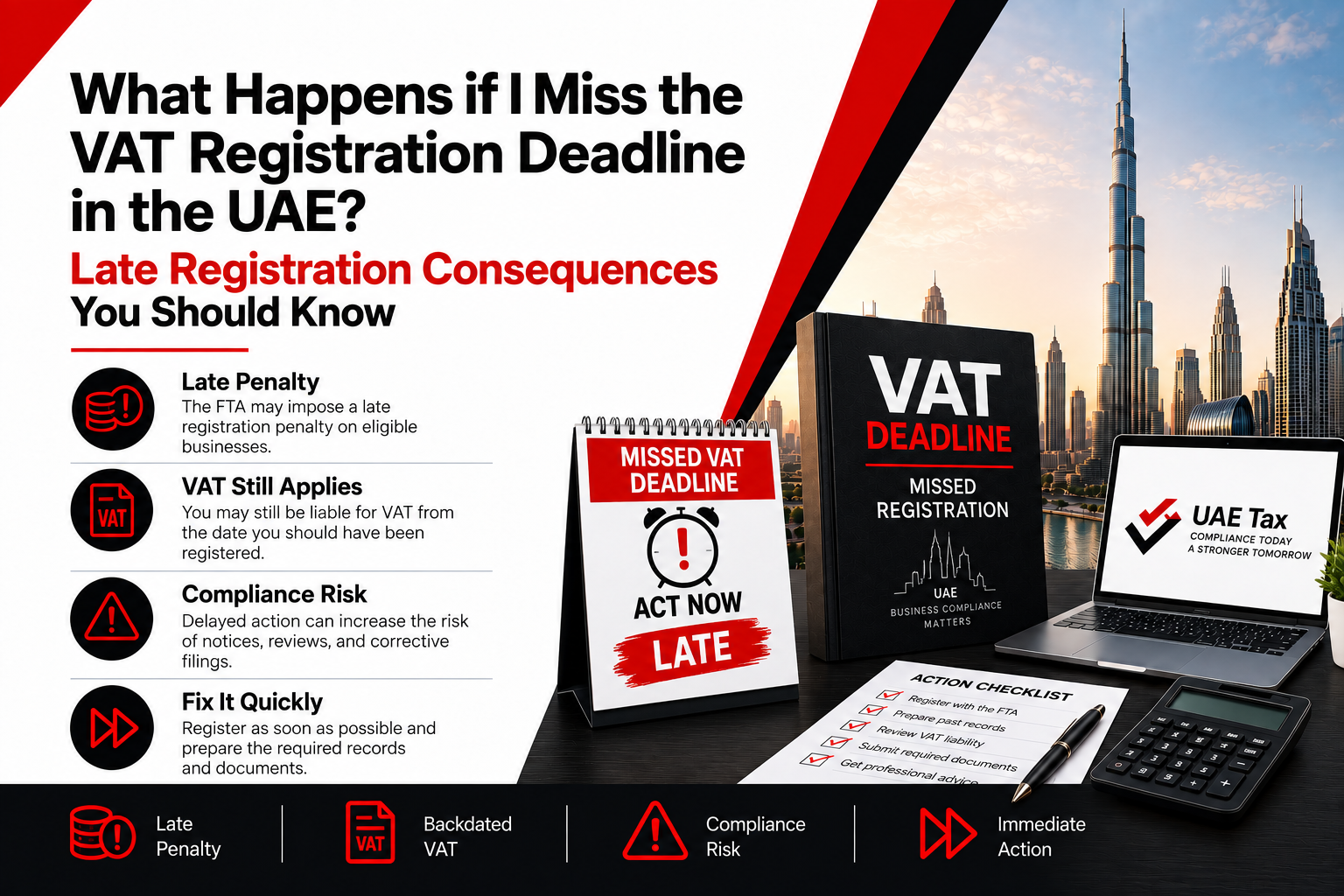
If you run a business in Dubai or anywhere else in the UAE and you have just realized your taxable turnover has crossed the mandatory threshold without a VAT registration in place, the question on your mind is probably simple: what happens now? The short answer is that the Federal Tax Authority (FTA) does not treat a missed VAT registration deadline lightly. There is a fixed financial penalty, a real chance of backdated tax liability, and a compliance record that can follow your business into future dealings with banks, free zone authorities, and government departments.
This guide walks through exactly what triggers the VAT registration deadline, what the FTA does when a business misses it, and the practical steps you can take today to limit the damage and get compliant.
Understanding the VAT Registration Deadline in the UAE
VAT registration UAE is not something a business chooses to do whenever it feels ready. Under UAE VAT law, registration becomes mandatory once a company's taxable supplies and imports exceed AED 375,000 within any rolling 12-month period. Once that threshold is crossed, the business has a fixed window, currently set at 30 days, to submit its VAT registration application through the FTA's EmaraTax portal.
There is also a voluntary registration threshold of AED 187,500. Businesses below the mandatory limit but above this figure can choose to register early, which is often a smart move for startups that expect rapid growth or that want to recover input VAT on setup costs.
Under UAE VAT law, you must submit your VAT registration application within 30 days of crossing the AED 375,000 threshold (or prior to 30 days under the forward-looking test). The 20 business days figure is the standard time the FTA takes to process an application once submitted. This is the detail that catches many companies out, especially fast-growing businesses in Dubai's retail, e-commerce, and services sectors where monthly revenue can spike unexpectedly.
What Happens If You Miss the VAT Registration Deadline?
Missing the deadline does not simply mean registering a little late. It sets off a chain of consequences that can affect your business finances and its standing with the FTA.
1. A Fixed AED 10,000 Administrative Penalty
The FTA applies a fixed late registration administrative penalty of AED 10,000 for businesses that fail to submit a VAT registration application within the required 30-day timeframe. This penalty is charged automatically whether or not taxable sales were made during the delay.
2. Backdated VAT Liability
This is the part that often costs businesses far more than the AED 10,000 fine. Once you register late, the FTA treats your VAT liability as starting from the date you should have registered, not the date you actually apply. That means you may owe 5% VAT on every taxable supply made during the gap period, even if you never charged your customers that VAT at the time. In practice, this can turn a single missed deadline into a five- or six-figure liability for a mid-sized business.
3. Interest and Ongoing Compliance Exposure
Unpaid VAT arising from a backdated liability can attract late payment charges in addition to the registration penalty itself. A business that registers late is also more likely to have late-filed returns for the periods it should have been registered, each of which can carry its own separate penalty.
4. A Flag on Your Compliance Record
The FTA keeps a compliance history for every taxable person. A late registration, especially one accompanied by late filings or unpaid tax, can make future interactions with the FTA more scrutinized, and can complicate matters such as VAT refunds, deregistration, or clearance certificates needed for bank facilities, tenders, and license renewals in Dubai and other emirates.
Quick Snapshot: The Cost of a Missed Deadline
✓ AED 10,000 fixed penalty for late VAT registration
✓ Backdated 5% VAT on supplies made since the threshold was crossed
✓ Possible late filing and late payment penalties stacking on top
✓ A weaker compliance record with the FTA going forward
How the FTA Calculates What You Owe
When a business registers for VAT after the deadline, the FTA does not simply apply the penalty and move on. It works out an effective registration date based on when the AED 375,000 threshold was crossed, then treats every taxable supply from that date onward as if VAT should have been charged. The business is expected to account for that VAT even where it was not collected from customers, which is why many companies end up absorbing the tax themselves rather than passing the cost on retroactively.
For a business that discovers it crossed the threshold several months earlier, this calculation can be significant. A company invoicing AED 100,000 a month that was six months late in registering could face roughly AED 30,000 in backdated VAT alone, on top of the AED 10,000 penalty.
Can the Penalty Be Reduced or Waived?
The FTA does allow certain routes for businesses to correct a late registration and limit further damage, though the AED 10,000 fixed penalty itself is rarely waived once triggered.
1. Register immediately. Every additional day of delay adds to the backdated liability and increases the risk of separate late filing penalties for periods after registration should have started.
2. File a voluntary disclosure. If errors in tax reporting have already occurred because of the late registration, submitting a voluntary disclosure before the FTA opens an audit is generally treated more favorably than being caught during an inspection.
3. Submit a reconsideration request. Where there are genuine, documented grounds, such as a demonstrable error by a service provider or a system issue on EmaraTax, a business can file a reconsideration request asking the FTA to review the penalty. This is assessed case by case and success is not guaranteed.
4. Keep supporting evidence ready. Bank statements, sales invoices, and accounting records that clearly show when the threshold was crossed help both the business and its tax advisor calculate the correct backdated liability and avoid over- or under-declaring.
Because the rules around penalties and waivers are periodically updated by Cabinet Decision, it is worth confirming the current position with a registered tax agent or directly on the FTA's EmaraTax portal before relying on any specific figure.
How to Register for VAT in the UAE
Create or log in to an EmaraTax account using the business's trade licence details.
Complete the VAT registration form with details of the business activity, expected turnover, and bank information.
Upload supporting documents, including the trade licence, Emirates ID and passport copies of owners or partners, and financial statements or turnover declarations.
Submit the application and respond promptly to any FTA request for additional information.
Once approved, note the effective registration date carefully, as this determines which periods require VAT returns and payment.
Businesses that are already past the deadline should not wait for a more convenient time to apply. The registration itself does not become more difficult with time, but the financial exposure from backdated VAT grows with every month of delay.
Why This Matters More for Growing Businesses in Dubai
Dubai's business environment rewards speed, and that is exactly why VAT registration deadlines catch so many growing companies off guard. A business that lands a large contract, opens a second outlet, or scales an e-commerce operation can cross the AED 375,000 threshold within a single quarter. Unlike corporate tax, which is assessed annually, VAT registration is triggered the moment turnover crosses the line, which means finance teams need to monitor rolling 12-month revenue continuously rather than only at year end.
Working with an accounting partner that tracks this threshold on your behalf, and flags it well before the 30-day window opens, is one of the simplest ways to avoid the entire situation.
Final Thoughts
Missing the VAT registration deadline in the UAE is a common but expensive mistake, and the cost rarely stops at the AED 10,000 penalty. Backdated VAT, potential late filing charges, and a weaker compliance record can affect a business for years after the initial slip. The most effective response is also the simplest one: register as soon as the threshold is crossed, or the moment a missed deadline is discovered, and get professional advice before the FTA does.
Need help registering for VAT or fixing a late registration?
Saeed Accounting works with businesses across Dubai and the UAE on VAT registration, EmaraTax filings, and FTA compliance, helping you resolve a missed deadline with minimum cost and get your VAT records back on track.
Frequently Asked Questions
Is the VAT registration deadline the same for every business in the UAE?
Yes. The 30-day window from the date the AED 375,000 threshold is crossed applies to mainland, free zone, and sole establishment businesses alike, wherever they are based in the UAE.
What if my business has not yet reached AED 375,000 but expects to soon?
You can register voluntarily once turnover exceeds AED 187,500, which avoids any risk of missing the mandatory deadline later and allows earlier recovery of input VAT.
Does the penalty apply if I have not made any sales yet?
The AED 10,000 penalty applies based on missing the registration window itself, regardless of whether taxable supplies were actually made during the delay.
Can a tax agent help reduce my exposure?
A registered tax agent cannot guarantee a waiver, but can help calculate the correct backdated liability, prepare a voluntary disclosure if needed, and ensure the registration and any reconsideration request are filed correctly the first time.