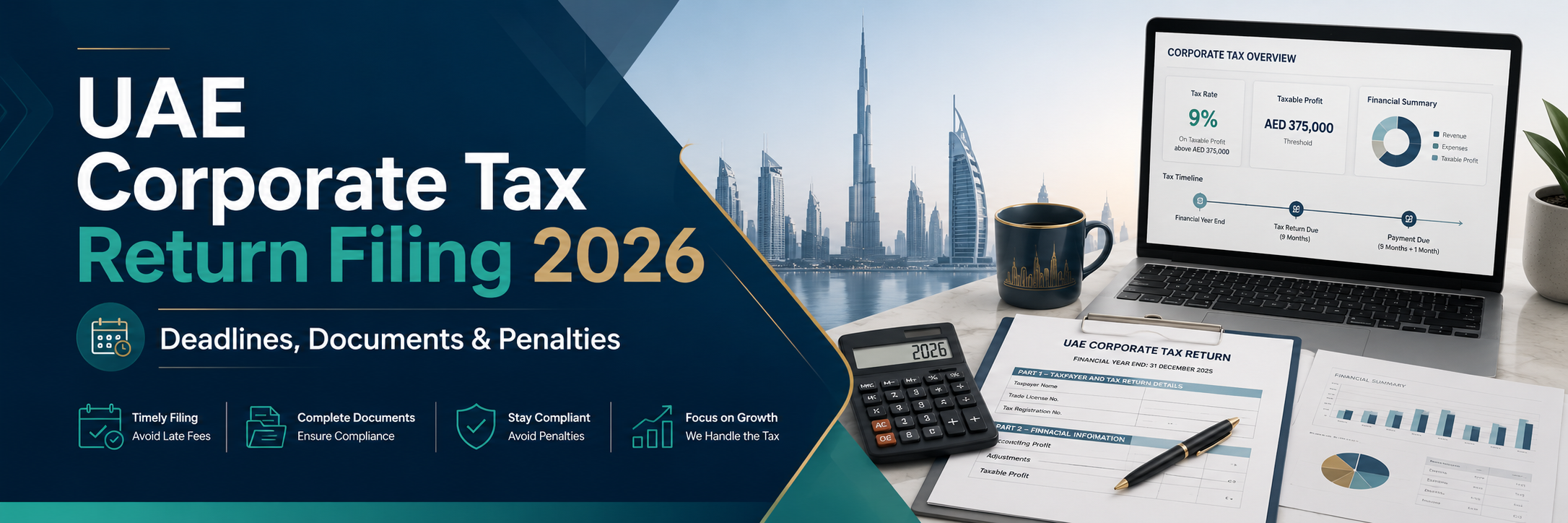
UAE Corporate Tax Return Filing 2026: Deadlines, Documents & Penalties
Corporate Tax compliance has become an important responsibility for businesses operating in the UAE. Registering for Corporate Tax is only the beginning. Once registered, businesses must maintain proper accounting records, calculate their taxable income correctly, submit their Corporate Tax Return, and pay any tax due within the prescribed deadline.
For many UAE businesses, 2026 will be an important Corporate Tax filing year. Companies with a financial year ending on 31 December 2025 will generally have to submit their Corporate Tax Return and settle the tax payable by 30 September 2026.
Missing the deadline can result in administrative penalties, so businesses should start preparing their financial records well before their filing date.
This guide explains the UAE Corporate Tax return filing process for 2026, including deadlines, required documents, penalties, common mistakes, and the steps businesses should take to remain compliant.
What Is a UAE Corporate Tax Return?
A Corporate Tax Return is a formal declaration submitted to the Federal Tax Authority (FTA) showing the financial and tax information of a taxable person for a particular tax period.
The return may include information relating to:
- Business revenue and income
- Accounting profit or loss
- Tax adjustments
- Taxable income
- Applicable exemptions or reliefs
- Tax credits, where applicable
- Corporate Tax payable
- Other information required by the FTA
The purpose of the return is to determine the final Corporate Tax liability of the business for the relevant tax period.
Submitting a Corporate Tax Return is different from Corporate Tax registration. Registration gives the business a Corporate Tax Registration Number, while return filing reports the taxable results of the business to the FTA.
Who Needs to File a Corporate Tax Return in the UAE?
Businesses and other taxable persons registered for UAE Corporate Tax generally need to submit a Corporate Tax Return for each applicable tax period.
This can include:
- UAE mainland companies
- Free zone companies
- Limited Liability Companies
- Establishments that fall within Corporate Tax requirements
- Foreign companies with a taxable presence in the UAE
- Certain natural persons conducting business activities
- Other taxable persons covered by UAE Corporate Tax legislation
Certain exempt persons may also have reporting or declaration requirements depending on their circumstances.
What If the Company Had No Income?
A company may still have a filing obligation even when:
- It did not generate revenue
- It had no sales during the year
- It recorded a loss
- It temporarily stopped trading
- It only incurred expenses
A business should therefore not assume that having zero revenue automatically removes its Corporate Tax compliance responsibilities.
UAE Corporate Tax Filing Deadline in 2026
As a general rule, a Corporate Tax Return must be submitted within nine months from the end of the relevant tax period.
Corporate Tax payable is generally due within the same period.
Example
If a company's financial year is:
1 January 2025 to 31 December 2025
The normal Corporate Tax filing and payment deadline will be:
30 September 2026
Businesses with different financial year-end dates will have different filing deadlines.
Companies should therefore confirm their own tax period instead of assuming that every UAE business has the same Corporate Tax deadline.
Why You Should Not Wait Until the Filing Deadline
Corporate Tax filing requires more than simply entering annual revenue into the EmaraTax portal.
Before filing, businesses may need to:
- Complete bookkeeping
- Reconcile bank accounts
- Review sales and purchases
- Check business expenses
- Finalise financial statements
- Identify non-deductible expenses
- Review related-party transactions
- Calculate taxable income
- Review available reliefs
- Determine the final Corporate Tax payable
If accounting records are incomplete, preparing the Corporate Tax Return at the last minute can create unnecessary compliance risks.
Starting early gives the business enough time to identify and correct accounting errors before submission.
Documents Required for Corporate Tax Return Filing
The exact documents required depend on the size, activities, structure, and tax position of the business. However, businesses should generally prepare the following records.
1. Corporate Tax Registration Details
Keep your Corporate Tax Registration Number and registration information available.
2. Trade Licence
A copy of the company's valid trade or commercial licence should be maintained as part of the company's compliance records.
3. Financial Statements
The financial statements should accurately reflect the company's financial activities during the relevant tax period.
These may include:
- Profit and loss statement
- Balance sheet
- Cash flow information, where applicable
- Supporting schedules
4. Trial Balance
The final trial balance helps verify income, expenses, assets, liabilities, and other accounting balances used when preparing the return.
5. General Ledger
The general ledger provides detailed information supporting individual accounting entries and tax calculations.
6. Bank Statements
Business bank statements should be reconciled with the accounting records before the Corporate Tax Return is prepared.
7. Sales and Purchase Records
Businesses should maintain supporting records for:
- Sales invoices
- Purchase invoices
- Credit notes
- Debit notes
- Expense documents
8. Fixed Asset Register
Businesses owning fixed assets should maintain records relating to asset costs, depreciation, additions, disposals, and other relevant adjustments.
9. Related-Party Information
Transactions with owners, directors, group companies, related parties, and connected persons may require additional review under UAE Corporate Tax rules.
10. Supporting Tax Documents
Depending on the company's situation, additional documentation may be required for tax adjustments, exemptions, reliefs, elections, tax credits, or other Corporate Tax positions.
How to File a Corporate Tax Return Through EmaraTax
Corporate Tax Returns are submitted electronically through the FTA's EmaraTax platform.
Step 1: Log in to EmaraTax
Access the EmaraTax account linked to the company's tax profile.
Step 2: Select the Relevant Taxable Person
If multiple businesses are linked to the account, select the company for which the Corporate Tax Return needs to be submitted.
Step 3: Open the Corporate Tax Section
Navigate to the Corporate Tax section and locate the relevant tax period and available return.
Step 4: Review Taxable Person Information
Confirm that the company's registration details and tax-period information are correct before proceeding.
Step 5: Enter Financial Information
Enter the required financial information based on the company's finalised accounting records.
Step 6: Calculate Tax Adjustments
Accounting profit is not always the same as taxable income. Certain accounting expenses or income may require adjustments under UAE Corporate Tax rules.
Step 7: Review Reliefs and Elections
Where applicable, review whether the company qualifies for any available relief, exemption, election, or other relevant tax treatment.
Step 8: Calculate Corporate Tax Payable
After completing the required information and adjustments, determine the company's final Corporate Tax liability.
Step 9: Review the Return
Check all information carefully before submission. Incorrect information may result in additional tax, penalties, or the need for corrective action.
Step 10: Submit the Return and Pay the Tax
Submit the completed return through EmaraTax and settle any Corporate Tax payable within the applicable deadline.
The exact portal screens or field names may change as the FTA updates EmaraTax, so businesses should follow the latest instructions available on the portal.
UAE Corporate Tax Rates
For businesses subject to the standard UAE Corporate Tax regime, the general Corporate Tax rates are:
- 0% on taxable income up to AED 375,000
- 9% on taxable income exceeding AED 375,000
Special rules can apply to certain businesses, including qualifying free zone persons and large multinational groups.
Businesses should therefore assess their own tax position instead of applying the standard rates without reviewing the relevant Corporate Tax rules.
Corporate Tax Late Filing Penalties
Businesses should take Corporate Tax filing deadlines seriously.
Failure to submit a Corporate Tax Return within the required timeframe may result in administrative penalties.
- AED 500 per month or part of a month during the first 12 months
- AED 1,000 per month or part of a month from the 13th month onwards
Additional penalties may also apply where Corporate Tax payable is not settled within the required timeframe.
Apart from penalties, late filing may make future tax compliance more complicated and could require additional corrective action with the FTA.
Common Corporate Tax Filing Mistakes to Avoid
1. Filing Without Completing the Accounts
Corporate Tax calculations should be based on accurate accounting information. Submitting figures before completing the books can result in incorrect taxable income.
2. Assuming VAT Profit Equals Corporate Tax Profit
VAT and Corporate Tax are separate taxes with different rules. Figures used for VAT filings cannot simply be treated as Corporate Tax figures without reviewing the financial records.
3. Ignoring Non-Deductible Expenses
Not every accounting expense is automatically deductible for Corporate Tax purposes. Expenses should be reviewed before calculating taxable income.
4. Missing Related-Party Transactions
Transactions involving shareholders, directors, related companies, and connected persons should be properly identified and reviewed.
5. Filing a Nil Return Without Checking the Accounts
A company with no sales may still have expenses, assets, liabilities, shareholder transactions, or other accounting activity.
The books should still be reviewed before treating the return as a nil or loss position.
6. Waiting Until the Final Week
Incomplete bookkeeping or missing documents discovered immediately before the deadline can delay the filing process.
Preparing early can significantly reduce this risk.
Why Proper Bookkeeping Is Important for Corporate Tax
Corporate Tax compliance starts with accurate accounting records.
Without proper bookkeeping, businesses may face difficulties determining:
- Actual revenue
- Allowable expenses
- Accounting profit
- Tax adjustments
- Taxable income
- Corporate Tax payable
Good bookkeeping also provides supporting documentation if the FTA requests clarification regarding information included in a Corporate Tax Return.
Businesses should therefore keep their accounting records updated throughout the year instead of preparing everything only when the Corporate Tax deadline approaches.
How Saeed Accounting Can Help
Corporate Tax filing requires careful coordination between accounting records, financial statements, tax adjustments, and FTA requirements.
Saeed Accounting can assist businesses with Corporate Tax compliance from preparation through filing.
Our Corporate Tax support can include:
- Corporate Tax registration review
- Bookkeeping and account finalisation
- Financial statement preparation
- Corporate Tax computation
- Tax adjustment review
- Corporate Tax Return preparation
- EmaraTax filing support
- Corporate Tax payment guidance
- Review of filing deadlines
- Ongoing Corporate Tax compliance assistance
Whether your company is actively trading, newly established, making a profit, reporting a loss, or currently inactive, it is important to review its Corporate Tax obligations before the filing deadline.
Frequently Asked Questions
When is the UAE Corporate Tax Return deadline?
A Corporate Tax Return is generally due within nine months from the end of the relevant tax period.
For example, a business with a tax period ending on 31 December 2025 would generally have a filing deadline of 30 September 2026.
Do I need to file Corporate Tax if my company has no income?
A registered company may still have a filing obligation even if it had no revenue or active business during the tax period. Its individual tax position should be reviewed before the filing deadline.
Can I file the Corporate Tax Return myself?
Taxable persons can generally submit their own Corporate Tax Returns through EmaraTax. However, businesses should ensure that their accounting records, tax adjustments, and declarations are accurate before submission.
Is Corporate Tax filing the same as Corporate Tax registration?
No. Corporate Tax registration is the process of registering the taxable person with the FTA and obtaining a Corporate Tax Registration Number.
Corporate Tax return filing is the subsequent process of reporting the company's financial and taxable results for a specific tax period.
What happens if I miss my Corporate Tax filing deadline?
Administrative penalties can apply for late submission of a Corporate Tax Return. Additional penalties may also arise if Corporate Tax payable is not settled by the applicable deadline.
Get Professional Corporate Tax Filing Support in the UAE
Corporate Tax compliance should not be left until the last minute.
If your Corporate Tax filing deadline is approaching, make sure your accounting records are complete, your taxable income has been calculated correctly, and your return is ready before the due date.
Saeed Accounting can help you prepare and file your UAE Corporate Tax Return accurately and on time.
Contact our team today for professional Corporate Tax filing, bookkeeping, accounting, and tax compliance support in the UAE.